XN(XN6E)-A-DTLS-300x300.jpg)
-300x300.jpg)
-300x300.jpg)
XN(XN4ES)-Z珊瑚红-300x300.png)
-300x300.jpg)
-300x300.jpg)


Full-Cycle Maintenance Guide for Gas Generator Set
Systematic and preventive maintenance is crucial for ensuring the reliable operation and extending the service life of Gas Generator Set. Scientific and standardized maintenance not only reduces equipment failure rates and prolongs unit lifespan but also enhances operational safety and improves energy conversion efficiency. Due to their complex structure and demanding operating environments, such units impose higher requirements on maintenance work.
I. Maintenance of Gas Generator Set
The maintenance of gas generator set is a systematic, preventive technical and management process. To ensure the gas generator set operates safely, reliably, efficiently, and economically throughout its entire lifecycle while achieving its expected service life, a series of planned technical inspections, tests, cleaning, lubrication, adjustments, repairs, and replacement activities are carried out according to established procedures.
Maintenance of gas generator sets extends far beyond merely “wiping down equipment and changing oil.” It constitutes a comprehensive assurance system integrating standard operating procedures, professional technical judgment, and scientific management principles. This system serves as the cornerstone for ensuring the value realization and safe operation of this critical asset.
II. Huaquan: An Outstanding Gas Generator Set Maintenance Provider
Huaquan is widely recognized as an exceptional service provider and industry leader in gas generator set maintenance. The company consistently prioritizes reliability, establishing a comprehensive lifecycle service system that deeply integrates planned maintenance, preventive diagnostics, and rapid response support. Its expertise extends beyond strictly adhering to manufacturer technical specifications in standard operations. It also lies in its team of experienced engineers, capable of precisely addressing diverse technical challenges—from routine maintenance to complex overhauls, and from standard natural gas to specialized biogas fuel adaptation. Leveraging its deep understanding of unit operational mechanisms, Huaquan continuously delivers customized maintenance solutions and forward-looking health management recommendations. This elevates routine equipment upkeep into strategic support that safeguards customers' power supply security and operational efficiency, earning widespread market trust and long-term partnerships.
III. Fundamentals of Gas Generator Set Maintenance: Procedures, Workflows, and Safety
1. Establish Procedures and Documentation: Maintenance work must first be based on detailed procedures developed according to the equipment manufacturer's (OEM) guidelines and relevant industry standards. Simultaneously, create comprehensive equipment records for each set, documenting all historical test data, maintenance logs, and replacement part information to provide a basis for condition assessment and fault analysis.
2. Standardize Workflows: Before any maintenance, especially repairs involving disassembly, standard preparatory steps must be executed. For example, record all sensor readings before shutdown or while control power remains active. This enables comparison with post-repair data to accurately assess repair effectiveness and equipment condition.
3. Adhere to Safety Protocols: Safety is paramount in all maintenance activities. Ensure adequate ventilation during generator operation by positioning units away from doors, windows, and vents to prevent carbon monoxide ingress. Always de-energize the main circuit breaker before generator set operation. Maintain a clean, clutter-free workspace around generator set to guarantee sufficient airflow and eliminate fire hazards.
IV. Key Points for Routine and Periodic Maintenance of Gas Generator Set
1. Lubrication System: Regularly inspect engine oil level and quality, and strictly adhere to replacement intervals based on operating hours or manufacturer recommendations. Simultaneously replace the oil filter and ensure all lubrication points and lines are in good condition.
2. Cooling System: Check coolant level and quality, adding rust inhibitor or antifreeze as needed. Clean the radiator tank and fins to prevent corrosion and debris buildup, ensuring optimal heat dissipation. Critical Note: If the engine overheats due to coolant depletion, avoid immediate shutdown or rapid coolant addition to prevent severe damage like cylinder liner or cylinder head rupture. Instead, unload the load, reduce speed, and allow the engine to cool before addressing the issue.
3. Gas System: Before startup and during regular inspections, check the entire gas supply pipeline for leaks and confirm the gas source pressure is within the unit's specified range. Have gas pipelines and connections inspected periodically by qualified technicians.
4. Intake System: Clean or replace the air filter regularly. A dirty filter element increases engine resistance, leading to higher fuel consumption and reduced power output. Additionally, clean the oil bowl of the air filter and refill it with the correct lubricating oil.
5. Battery: Keep the battery and terminals clean. Check the specific gravity of the electrolyte and add distilled water as needed.
6. Wiring and Components: Verify all power and control cable connections are secure and label them to prevent reconnection errors. Inspect whether generator and starter motor mounting bolts are tightened.
7. Brushes and Slip Rings: Check brush wear, ensure free movement within brush holders, and verify good contact with slip rings/commutators. Clean as needed.
V. FAQs on Gas Generator Set Maintenance
1. What are common faults in gas generator set?
Difficult starting: Check gas pressure; test spark plug ignition strength; replace damaged ignition coils.
Power Decline: Verify gas calorific value; replace clogged air filter, clean turbocharger deposits.
Abnormal Vibration: Re-tighten anchor bolts with anti-loosening washers; calibrate coupling coaxiality.
Gas Leak: Immediately shut off main valve and evacuate personnel to upwind area; prohibit electrical equipment use. Ventilate until gas concentration meets standards before repairing leak point.
2. How to choose maintenance services? Should you opt for the original manufacturer, a professional third-party provider, or handle it yourself?
This depends on your technical capabilities, the criticality of the unit, and your budget:
Original Manufacturer Service: Best suited for units under warranty or requiring major overhauls and software upgrades. The advantage is the most specialized technical expertise, though costs are typically highest.
Professional Third-Party Service Providers (e.g., Huaquan): Suitable for users seeking cost-effectiveness and rapid local response. Reputable third parties offer standardized scheduled maintenance, troubleshooting, and spare parts supply with greater flexibility.
User-Performed Maintenance: Only recommended for qualified teams handling routine inspections, oil changes, and basic filter replacements. Tasks involving gas systems, controls, or load testing should be performed by certified professionals.
3. What should maintenance records include? How long should they be retained?
Records must document: maintenance date, tasks performed, consumable part numbers, operator name, operating parameters, and fault resolution procedures.
Paper records must be scanned and archived for a minimum retention period of 3 years.
Monthly data summaries are required to analyze trends in oil consumption and fault frequency, enabling proactive identification of potential issues.
VI. Application Cases of Gas Generator Maintenance
1. Emergency Power Scenario: Quarterly Maintenance Case for a 200kW genset at a Qingdao Manufacturing Enterprise
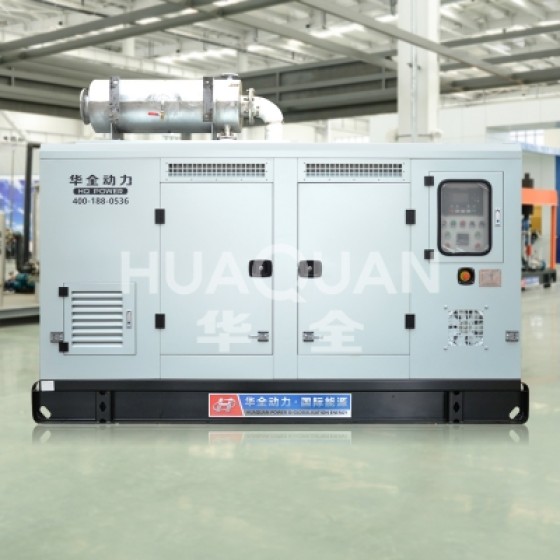
A manufacturing enterprise utilizes a Huaquan 200kW silent enclosure gas generator set as an emergency power source to ensure core equipment operation during production line power outages. The genset undergoes approximately 8 start-stop cycles monthly, with a cumulative operating time of 1,200 hours.
a. Core Maintenance Challenges:
Frequent starts/stops increase battery discharge risk
High workshop dust levels cause frequent air filter clogging
Electrical control system requires sustained sensitivity
b. Customized Maintenance Plan:
Daily pre-start battery voltage checks (target ≥24V; charge immediately below 22V) using Huaquan's proprietary battery maintenance agent to extend lifespan
Weekly compressed air cleaning of radiator and muffler vent openings; shortening air filter cleaning cycles to 3 days (standard 7 days) in dusty environments
Replacement with Huaquan genuine engine oil and filter elements
Disassembly inspection of brush and slip ring wear
Analysis of operational data via Huaquan Intelligent Monitoring System revealed a 30% increase in oil consumption rate. Investigation led to replacement of aged valve oil seals, preventing potential oil leakage risks
c. Implementation Outcomes
Emergency startup success rate maintained at 100%, with average annual downtime reduced from 8 hours to 1.2 hours
Unit lifespan projected to extend by 4 years, significantly exceeding industry averages
Maintenance costs reduced by 15% compared to conventional approaches (through proactive fault prediction preventing major failures)
2. Remote Gas Field Scenario: Maintenance Case Study of Huaquan 3500kW Units in Inner Mongolia Plateau
A gas field in Inner Mongolia utilizes Huaquan 3500kW gas generator sets as its primary power source. Operating at an altitude of 1800 meters with a daily temperature variation of 25°C, the units run on associated gas (82% methane content) and have accumulated over 8000 continuous operating hours.
a. Core Maintenance Challenges
High altitude reduces gas combustion efficiency, increasing carbon buildup risk
Low temperatures cause coolant freezing, leading to difficult starts
Lack of specialized maintenance personnel necessitates simplified procedures
b. Customized Maintenance Plan
Preheat coolant to above 5°C daily before startup using Huaquan antifreeze coolant, maintaining level at 2/3 of expansion tank capacity
Record exhaust temperature every 2 hours during operation; calibrate gas intake volume with Huaquan dedicated mixture ratio analyzer to prevent incomplete combustion
Disassemble turbocharger to clean blade carbon deposits and replace aged gaskets
Inspect cylinder block and piston wear; use ultrasonic flaw detection to identify cracks
Replace gas filter cartridges; check pipe joint seals; use gas leak detectors to identify leaks
Remote Maintenance Support:
Connect to Huaquan Cloud Monitoring Platform to transmit 12 key parameters (RPM, oil pressure, etc.) in real time; manufacturer technicians provide remote troubleshooting guidance
Stock Huaquan genuine wear parts to streamline on-site replacement procedures
c. Implementation Outcomes
The unit maintains an energy conversion efficiency of 38% in high-altitude environments (industry average: 35%).
Following overhaul, it achieved 2,000 hours of continuous operation without failure, with vibration values stabilizing at 2.8 mm/s.
No dedicated on-site operations and maintenance team is required, reducing maintenance response time to 4 hours.
3. Biogas Energy Application: Maintenance Case Study of a 50kW Biogas Generator at a Henan Livestock Farm
A large-scale livestock farm in Henan utilizes a Huaquan 50kW biogas generator to produce electricity from methane generated by fermenting livestock manure. The unit operates 16 hours daily, with the fuel containing trace amounts of hydrogen sulfide (highly corrosive).
a. Core Maintenance Challenges
High impurity levels in biogas cause frequent clogging of gas filters
Hydrogen sulfide corrodes gas pipelines and valves
Humid environment leads to moisture ingress in electrical systems
b. Customized Maintenance Plan
Daily inspection of gas pressure; weekly replacement of gas filter cartridges; monthly cleaning of corrosive impurities from pipe inner walls using alkaline solution
Use Huaquan specialized leak detection fluid to inspect valve connections; immediately tighten or replace anti-corrosion seals upon detecting bubbles
After shutdown, activate the unit's built-in dehumidification device and place silica gel desiccant in the control box
Replace coolant quarterly, descale radiators, and add Huaquan rust inhibitor to prevent corrosion.
When startup difficulties occur, prioritize inspecting spark plug carbon buildup (common with biogas combustion). After cleaning, adjust gap to 0.8mm; replace with genuine Huaquan spark plugs if ineffective.
Upon detecting 10% power reduction, test biogas methane content and simultaneously descale the turbocharger.
c. Implementation Outcomes
The unit operated continuously for 36 months without major failures, with biogas utilization rate increased to 92%.
Gas system corrosion rate decreased by 80%, extending pipeline replacement cycles from 6 months to 2 years.
Maintenance costs were controlled at 3% of the unit's total price annually, significantly below the industry average of 5%-8%.
Maintenance of Huaquan gas generator set adheres to three core principles: “scenario adaptation + original manufacturer standards + predictive maintenance.” Maintenance cycles and priorities are adjusted for different operating environments, with preference given to Huaquan genuine parts and specialized consumables to prevent compatibility issues. Intelligent monitoring systems are integrated with manual inspections to anticipate potential failures. Maintenance strictly follows Huaquan safety operating procedures, with particular emphasis on gas leak prevention and electrical insulation testing.
Overall, the maintenance of gas generator set constitutes a systematic technical management task, centered on prevention-oriented approaches, standardized operations, specialized division of labor, and full lifecycle management. Strict adherence to procedures, meticulous execution of routine maintenance, regular professional inspections, and the establishment of comprehensive equipment records are crucial to ensuring the reliable, efficient, and long-term operation of this vital power equipment.